High Ping In Escape From Tarkov: What Actually Causes It And What Works
 Last updated: 4 Aug, 2026
  6 min
6 minIn most shooters, a brief delay may cost you a firefight. In Escape from Tarkov, it can cost you the entire loadout you brought into the raid. A delayed peek, a late hit confirmation, or one unstable exchange can mean losing weapons and equipment collected over several hours.
That makes Tarkov players unusually sensitive to latency. However, not every high number means the same thing. A stable 90 ms connection can be manageable, while a 60 ms connection that suddenly jumps to 200 ms can ruin a close-range fight. Before changing settings, look at the behavior of your connection and compare it with the distance to your selected server.
A Practical Tarkov Ping Reference
| Ping | Likely experience |
|---|---|
| Below 30 ms | Excellent response, but uncommon unless the server is very close |
| 30 to 60 ms | Strong result for most players using a nearby regional server |
| 60 to 100 ms | Generally playable, with some delay during close-range fights |
| 100 to 150 ms | Noticeable delay and less reliable exchanges at short range |
| Above 150 ms | Difficult for serious play, especially when trades happen quickly |
These figures are guidelines, not strict limits. Physical distance sets the lowest result you can realistically achieve. A player in South America connecting to a European server cannot reach local-server latency through software. That delay comes from the route’s geography.
The other numbers deserve attention too. Jitter should remain relatively low, ideally below about 30 ms. Packet loss should be close to zero. In Tarkov, an unstable connection can be more damaging than a consistently high one because movement updates and damage confirmation may arrive unevenly.
Find the Pattern Before You Change the Settings
Your ping pattern often points to the cause more accurately than a single speed test.
| What you see | Most likely explanation |
|---|---|
| High but stable ping on every server | Physical distance or server selection |
| One nearby server performs much worse than expected | ISP routing |
| Ping rises when someone downloads or streams | Local network congestion |
| Ping jumps mainly on Wi Fi | Wireless interference or signal instability |
| Players in one region report the same spike | Server-side pressure or maintenance |
Start with the server list. If every available region shows a consistently high result, choose the closest server and treat that number as your baseline. There is no setting that can remove the distance between your home and the data center.
The more revealing case is a nearby server with unexpectedly high ping. Your ISP may be sending traffic through an inefficient route. Providers choose paths according to their own network arrangements and transit costs, not according to how well a particular Tarkov server performs. That is how a server that should feel relatively close can still show 90 ms or more.
Local congestion creates a different pattern. Tarkov does not need exceptional bandwidth, but it does need the connection to remain consistent. A Steam update, cloud backup, video stream, or large download on another device can add enough queueing to destabilize a raid. Wi Fi can produce similar symptoms through interference and brief signal drops.
💡We recommend using GearUP as an effective solution to reduce latency in Tarkov.
Check the Server Before Blaming Your Connection
Tarkov’s servers can struggle after major patches, during events, or when a regional service is under pressure. If players in the same region start reporting high ping or disconnections at the same time, your PC is probably not the main problem.
Check Battlestate Games announcements, the r/EscapefromTarkov community, and Downdetector. None of these sources is perfect on its own, but a sudden wave of matching reports is a strong reason to wait instead of changing DNS, reinstalling drivers, or rebuilding your network setup.
If the server situation looks normal, move to your own connection:
- Open Task Manager and sort processes by network usage.
- Stop downloads, cloud synchronization, video streams, and unnecessary browser activity.
- Check Steam and the Battlestate Games Launcher for pending updates.
- Pause heavy traffic on other devices connected to the same network.
- Compare Wi Fi with Ethernet if you have access to a wired connection.
Ethernet is especially valuable for Tarkov because it removes much of the jitter associated with wireless interference. A mediocre wired connection can feel more reliable than a fast Wi Fi connection that keeps fluctuating.
When the Default Route Is the Weak Point
Some players take high bandwidth as a guarantee of low latency, but you may have noticed your ping is still high.
That’s the problem: bandwidth refers to how much data you can transmit at once, while the key factor affecting Tarkov latency is network routing. The amount of data sent and received during gameplay is actually quite small; it’s like driving on a wide but heavily congested road. So what’s the solution? Of course, take a detour.
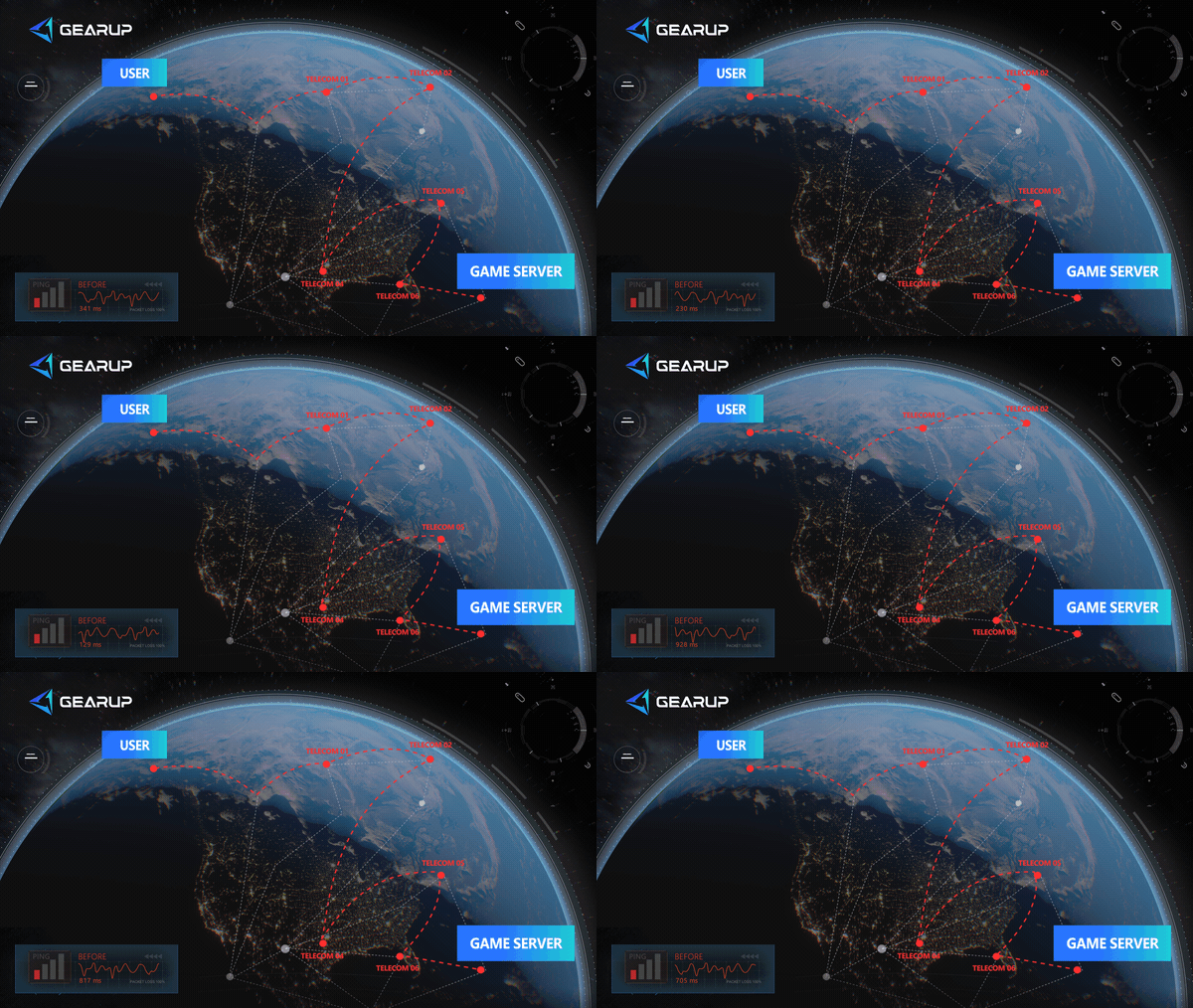
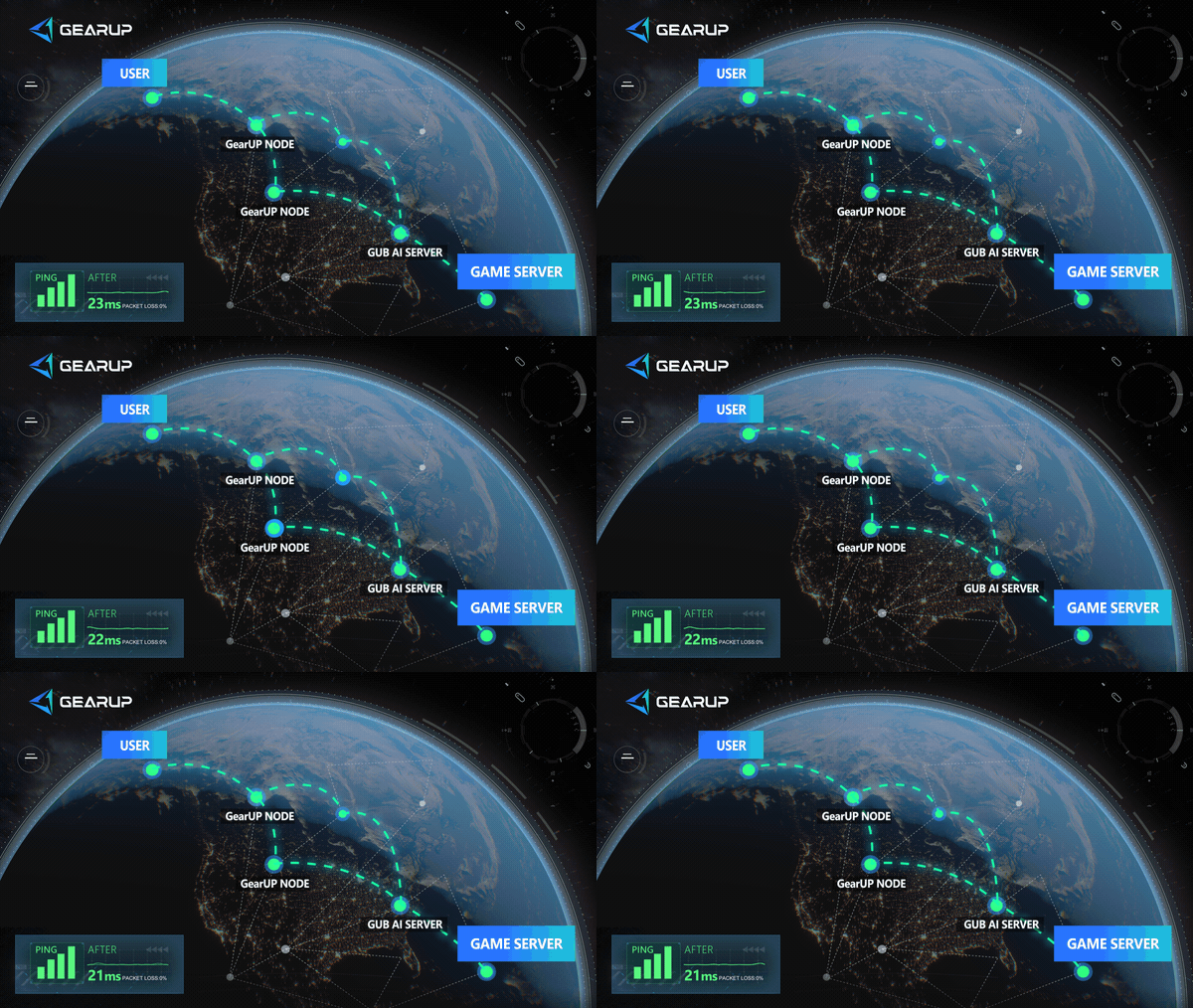
But players can’t manually detour (switch nodes); you need a dedicated tool like GearUP. Its nodes are deployed specifically around Tarkov’s servers, and its algorithms can calculate the best route in seconds, then complete the switch and connection.

Aside from targeted optimization, GearUP also features an ultra-minimal interface, which is another reason it’s so popular with Tarkov players.
What Usually Gets Blamed Without Helping
A consumer VPN rarely lowers Tarkov ping. It usually adds another detour, and a congested VPN endpoint can increase both latency and jitter.
DNS changes are also commonly misunderstood. DNS helps resolve the server address at the beginning of the connection. It does not control the route used by Tarkov during the raid, so changing DNS is unlikely to lower in-game ping.
Driver reinstalls, overclocking, and Windows performance tweaks belong to a different category. They may improve frame rate or input delay, but they do not change network latency. If Tarkov feels sluggish in offline menus or other non-network situations, investigate game performance separately.
Questions Players Usually Ask
Can Tarkov ping reach zero?
No. The distance between your device and the server creates a minimum delay. A very low result is possible only when the server is physically close.
Is 90 ms playable?
Yes, if it stays stable. A flat 90 ms connection can be more predictable than a 60 ms connection that repeatedly spikes during combat.
Why does my average ping look fine when the game still feels bad?
The average may hide jitter or packet loss. Watch for sudden changes, not only the number shown between exchanges.
Should I focus on ping or jitter first?
Stabilize the connection first. A slightly higher but consistent ping is usually easier to play around than a lower number that keeps changing.
The Realistic Target
The goal is not to force Tarkov into an impossible ping range. It is to reach the most stable connection your location, server choice, and network route can provide.
If the number is high everywhere, distance is probably setting the limit. If only one route performs badly, investigate your ISP path. If the number changes with downloads or Wi Fi conditions, fix the local network first. Once the connection stays flat throughout a raid, Tarkov becomes much more predictable, even when the final ping is not especially low.
About The Author
Ethan is one of GearUP's Technical Blog Editors, specializing in gaming network optimization and troubleshooting. With an in-depth understanding of GearUP's technologies, he creates clear, practical content that helps players identify the causes of network issues, understand how game acceleration works, and optimize their online gaming experience. By turning complex technical concepts into easy-to-follow guides, Ethan helps readers solve common connectivity problems and make better use of GearUP's features.
The End