How to Choose a Wi-Fi Booster
 Last updated: 22 Dec, 2025
  7 min
7 minA Wi-Fi booster promises one thing: take the signal you already have and make it reach farther or feel stronger. For casual web use, that’s often enough. For gaming, "more bars" alone doesn't fix rubber-banding, delayed peeks, or party voice that clips exactly when you need it most. To play cleanly, you need a booster that also keeps latency, jitter, and loss under control—end to end, not just inside your living room.
Wi‑Fi Booster, Extender, Mesh, and Router—What’s the Difference?
| Device / System | What it does | Notes / Pros & Cons |
|---|---|---|
| Range extender / repeater | Listens to your Wi‑Fi and re‑broadcasts it. | Simple and cheap, but it shares airtime with the original network — heavy traffic can effectively double the waiting line and add jitter. |
| Mesh system | Uses multiple nodes to spread coverage. | With a wired backhaul it’s great; with a wireless backhaul it still shares air and can inherit the same peak-time wobble you had before. |
| Traditional router upgrade | Improves radios and adds features like device priority (QoS). | Helps local performance, but even the fanciest router only sees your first mile; it doesn’t control the path your packets take across the wider internet at peak times (e.g., 9 p.m.). |
| Gaming‑focused booster | Combines local airtime management with route stability. | Should keep local airtime clean and hold a predictable route to the game’s servers when the network outside your home gets busy. |
What Makes a Booster Matter for Gaming?
Stable matches come from three things: a clean first mile (your room), a steady middle mile (the route across the internet), and a healthy session layer (NAT/UPnP). Boosters that only increase signal strength don’t address queueing, retransmissions, or path changes—exactly the stuff that turns a flat latency line into a saw blade. The right device reduces retries, prevents bufferbloat, and avoids route hopping when the ISP's peering gets crowded.
Where Simple Boosters Fall Short?
However, most Wi‑Fi boosters on the market today, for reasons of cost and size, typically do not have any advanced features. They are merely amplifiers that broadcast your current Wi‑Fi signal farther and increase signal strength, and they do not “think” for themselves. This means:
- They don’t prioritize small, time-sensitive game packets over bulk downloads and video streams, so your inputs often wait behind someone’s cloud backup.
- They can introduce extra wireless hops that add jitter even when the “bars” look full.
- They can’t stop your traffic from drifting to a faraway path that looked briefly fast on paper and then collapsed under load.
For gaming, a better answer combines Wi-Fi 6 efficiency, clear device priority, and route control that favors nearby, clean paths all evening.
HYPEREV: A Wi-Fi booster Built for Online Games
To achieve the most extreme optimization, the HYPEREV Gaming Router would be the best choice. First, it is a Wi‑Fi 6 network extension tool that provides 2.4 GHz and 5 GHz band signals and Wi‑Fi management features; you can use it as a normal Wi‑Fi booster to provide stable network access for other devices.
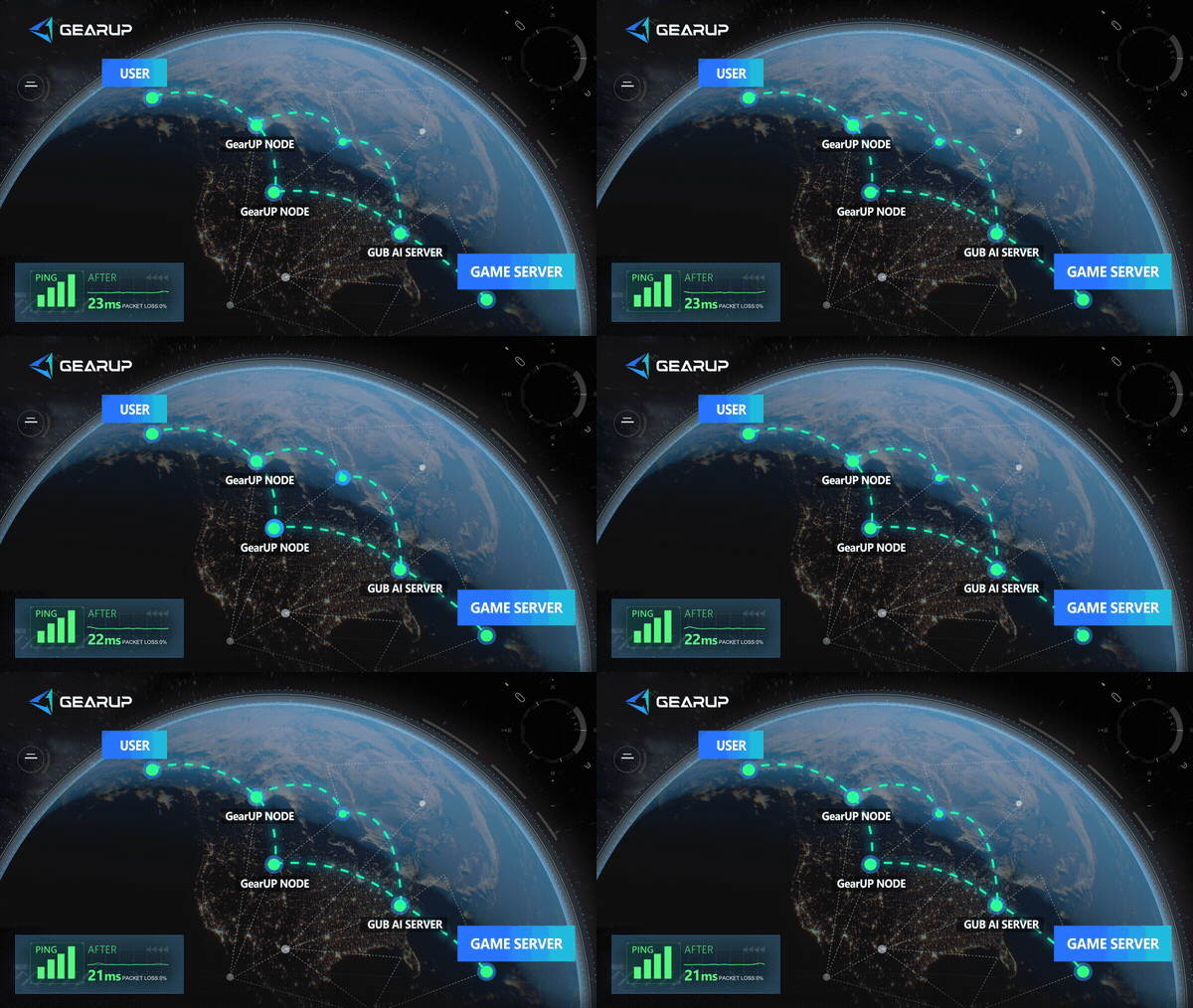
However, its true power is network connection optimization. Through an intelligent node‑adjustment algorithm, HYPEREV’s optimization can be fine‑grained down to each individual game server. In other words, after your device connects to its Wi‑Fi, it not only gets a stronger signal, but can also optimize the route to the game’s servers with one click, significantly reducing game ping and improving stability.
If you are a hardcore online gamer or need to play across regions, HYPEREV can provide recommended settings and an excellent smooth experience—effects that other Wi‑Fi boosters, even gaming routers, cannot achieve. Simply put, you spend money on one product but get two powerful product functions.

Do You Still Need to "Set Things Up"?
If you use HYPEREV, you don’t need to manually change network settings — one of its major advantages is that it’s plug‑and‑play: connect to any router and you can start optimizing the network and managing Wi‑Fi via the mobile app. However, you still need to pay attention to some everyday network usage habits; it is the “first mile” of data transmission, and if problems occur there, optimizations will be useless:
- Give your game device the best lane. Prefer Ethernet. If Wi-Fi is mandatory, use 5/6 GHz with line-of-sight and pick one clean channel. Don’t chase it nightly.
- Keep one gateway doing NAT. If you stacked your own router behind an ISP router, convert one to bridge or access-point** mode so you don’t end up with double NAT that breaks party chat.
- Enable UPnP on the actual gateway. Let sessions open and close predictably instead of juggling old manual port rules.
What Else You Need to Know About Wi‑Fi Boosters?
Q1: Can a Wi‑Fi booster replace a router?
No. Ordinary Wi‑Fi boosters typically have almost no other functions — they are more like loudspeakers that amplify or relay an existing Wi‑Fi signal farther away. If there is no base router emitting a signal, there is nothing for the booster to amplify. Even HYPEREV currently does not have dial‑up/PPPoe capability, so it still needs to be connected to a main router; HYPEREV will, however, adjust and optimize all traffic that connects to its Wi‑Fi.
Q2: What should you pay attention to when choosing a Wi‑Fi booster?
- Wi‑Fi standard (e.g., Wi‑Fi 6 / 6E) — determines protocol features, latency, and concurrent performance.
- Supported frequency bands (2.4 GHz / 5 GHz / 6 GHz) — affects range, wall penetration, available bandwidth, and interference.
- Backhaul and Ethernet ports (wired/Gigabit or multi‑Gig) — wired backhaul significantly improves stability and real‑world throughput.
- Antenna count & MIMO/spatial streams (and MU‑MIMO/OFDMA support) — directly impacts multi‑device performance and coverage quality.
Q3: After using a Wi‑Fi booster can I remove the router’s antennas?
No — you generally should not remove the router’s antennas. Modern routers, especially high‑end models, use multiple antennas to achieve more stable and higher‑capacity signal transmission. Reasons:
- Multiple antennas enable MIMO and multiple spatial streams, which increase throughput and capacity.
- Antenna diversity and beamforming improve range, reliability and signal quality for different client locations.
- Removing antennas changes the RF matching and radiation pattern, which usually degrades coverage and throughput and in some designs can stress the radio front end.
If antennas are detachable, you can replace them with approved replacements per the manufacturer’s guidance, but simply removing them is not recommended. Always check the router’s manual before changing antennas.
Q4: Why Wi-Fi 6 matters more than signal bars?
Wi-Fi 6 adds scheduling tools (like OFDMA and better multi-user handling) that let the access point serve multiple devices in one slice of airtime. That shortens queues, cuts retransmissions, and trims the micro-stutters you feel as “lag” when the house is busy. It won’t move you closer to a remote server, but it flattens jitter—and your hands notice that first.
Conclusion
A Wi-Fi booster that only raises signal bars won’t protect your ranked night. For gaming, the win is a clean first mile and a route that stays near home when everyone comes online. HYPEREV treats boosting as stability: Wi-Fi 6 that behaves, device priority that prevents queueing, game fancing to stop route wander, and full-path boost that keeps the whole trip predictable—without touching game files or anti-cheat. Set it up beside your ISP gateway, tap Boost, and play with a line you can finally trust.
About The Author
Ethan is one of GearUP's Technical Blog Editors, specializing in gaming network optimization and troubleshooting. With an in-depth understanding of GearUP's technologies, he creates clear, practical content that helps players identify the causes of network issues, understand how game acceleration works, and optimize their online gaming experience. By turning complex technical concepts into easy-to-follow guides, Ethan helps readers solve common connectivity problems and make better use of GearUP's features.
The End