Choosing the Best Wi‑Fi 6 Router: A Buyer’s Guide
 Last updated: 16 Dec, 2025
  7 min
7 minA fast router that spikes the moment the house gets busy is not a gaming router. What you want is a box that keeps latency, jitter, and loss under control while everything else in your home does its thing. Wi-Fi 6 helps, but logos alone don’t guarantee clean rounds. This guide sets practical expectations, shows how mainstream brands behave in real homes, and explains why HYPEREV focuses on stability first.
Key Points of Wi‑Fi 6 Gaming Routers
Why Choose Wi‑Fi 6?
Nowadays, routers on the market range from basic Wi‑Fi 5 to the latest Wi‑Fi 7, so many gamers are puzzled about why Wi‑Fi 6 would be the best choice — we can briefly compare:
| Factor | Wi‑Fi 5 (802.11ac) | Wi‑Fi 6 (why choose) | Wi‑Fi 7 (why not yet) |
|---|---|---|---|
| Multi‑device performance | No OFDMA, more contention | OFDMA + improved MU‑MIMO — better under load | Even better in theory, but few client devices yet |
| Latency & stability (gaming) | Higher jitter under load | Lower, more consistent latency (scheduling, TWT) | Potential gains, but firmware/ecosystem immature |
| Peak throughput | Lower (256/1024‑QAM limits) | Higher (1024‑QAM) — enough for gaming | Much higher (4096‑QAM, 320 MHz), often unnecessary now |
| Compatibility & cost | Cheap but aging | Widely supported, best cost/benefit today | Expensive; limited regional/channel use and few devices |
| Practical recommendation | OK for basic use | Best immediate upgrade for gamers | Wait unless you need extreme future bandwidth and have compatible devices |
If you prefer an even shorter single sentence: Wi‑Fi 6 gives you today’s best mix of low latency, reliable multi‑device performance and broad device support at a reasonable price — Wi‑Fi 5 is dated and Wi‑Fi 7 is still largely premature for most gamers.
What "Best" Means for Gaming?
Peak throughput sells boxes; consistency wins fights. The right router keeps the first mile (your living room) boring and predictable, so inputs, state updates, and party voice don’t queue behind bulk traffic.
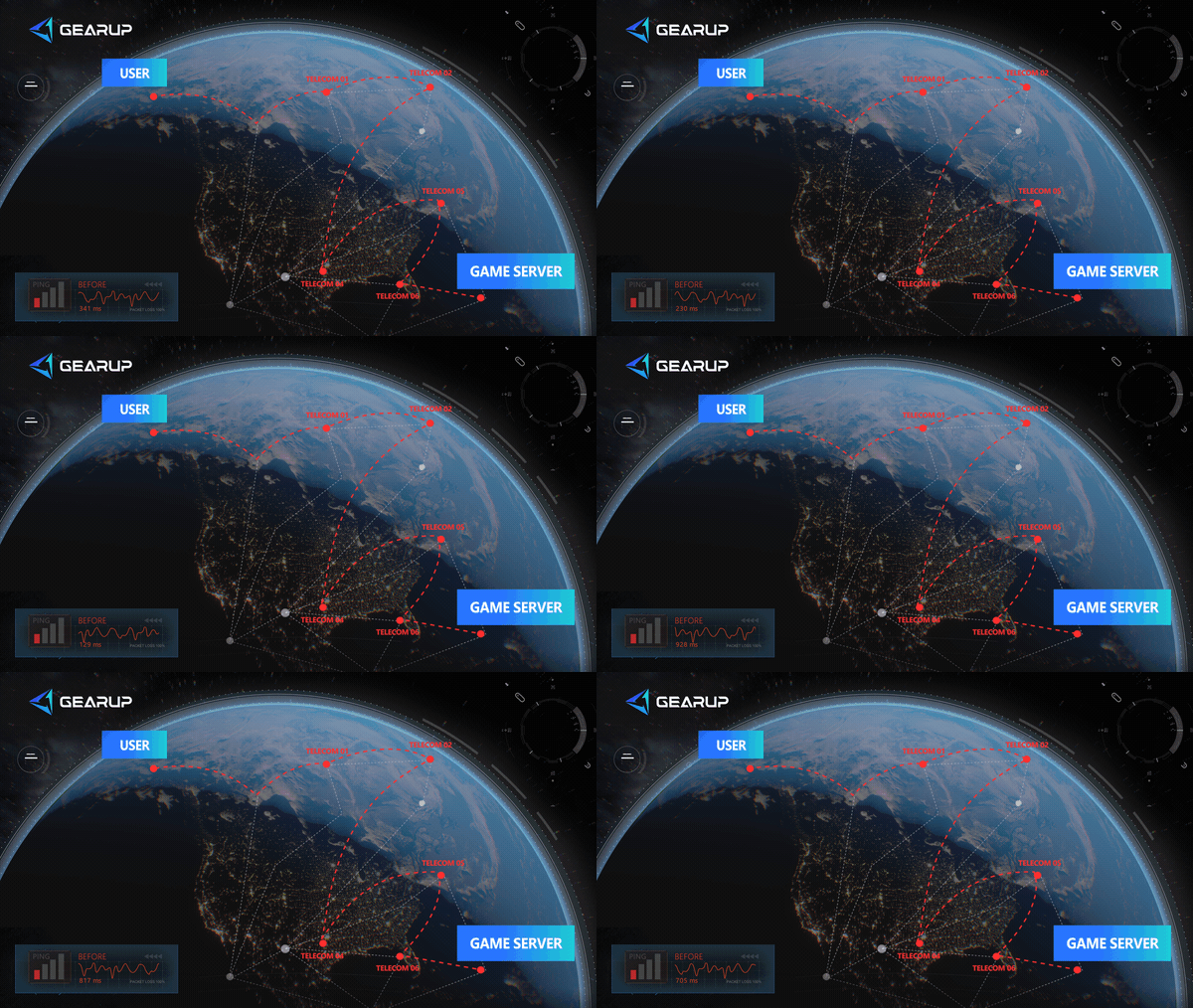
At night, the middle mile—the route across the internet—can wander. A gaming router should give you tools to keep paths near home and avoid mid-match surprises. Judge success by a flat line, not a record-low number you saw once at noon.
Two Important Wi‑Fi 6 Technologies
- OFDMA lets the access point schedule several clients in one slice of airtime. That shortens queues, reduces retries, and trims the micro-stutters you feel as "lag" when multiple devices are active.
- Modern MU-MIMO improves how uplink and downlink share the radio among many talkers. For players, that means inputs and voice packets don’t wait behind someone’s upload.
Features alone aren’t magic. You still need sane placement, a clean 5/6 GHz channel, and device priority so short game packets don’t sit behind cloud backups.
Buying Criteria that Matter on Consoles and PC
- Prefer routers that make device priority obvious. If you can mark your console/PC as “high priority” in two taps, you’ll actually use it. Inputs and voice should keep their place even when the TV starts streaming.
- Look for UPnP that just works and a clear way to avoid double NAT. One gateway should perform NAT; everything else should extend coverage, not translate addresses again.
- Favor models that expose live latency or at least give a simple graph you can read before queuing. If you cannot see whether the line is flat at 9 p.m., you will end up guessing.
How to Choose a Wi-Fi 6 Router Brand?
We summarized a comparison of Wi‑Fi 6 routers from several mainstream brands. It should be noted that among routers of the same tier, the differences in everyday use between different brands are not particularly large, but each brand, because of differences in price and audience, will have some differences in advanced usage:
| Brand | Representative Wi‑Fi 6 models | Approx. price tier (USD) | Key strengths | Typical weaknesses | Best for |
|---|---|---|---|---|---|
| Asus | ROG Rapture GT-AX11000, RT-AX86U Pro, TUF Gaming AX6000 | Mid → High ($250–$450) | Top performance, rich gaming QoS/features, AiMesh for mesh, strong customization | Premium price; UI/features can be complex for casual users | Power users / streamers / homes wanting mesh + advanced tuning |
| Netgear (Nighthawk) | XR1000 (DumaOS), RAX120, RAX200, Orbi Wi‑Fi 6 mesh | Mid → High ($200–$500) | Gamer tools (some models), consumer-friendly UI, reliable throughput | Fragmented features across models; some features behind subscription (Netgear Armor) | Gamers wanting easy latency control / households wanting simple setup |
| TP‑Link | Archer AX11000, Archer GX90, Archer AX73/AX50 | Low → Mid ($100–$300) | Excellent value, easy setup/app, stable core features, HomeCare security | Fewer ultra-advanced tuning options | Budget-conscious gamers / families wanting solid performance |
| Linksys | MR9600, Velop MX10 (AX mesh), Hydra Pro 6 (AX) | Mid ($150–$400) | Good mesh options (Velop), solid legacy brand support, straightforward UI | Some high-end features less customizable than Asus; fewer gamer‑specific tools | Users wanting reliable mesh + simple management |
| D‑Link | DIR-X5460 (EXO AX5400), DIR-X6060, EXO/AX series | Low → Mid ($120–$350) | Competitive pricing, easy setup, decent core performance, wide retail availability | Firmware/UI can be less polished vs competitors; fewer enthusiast features | Cost-sensitive buyers wanting mainstream performance |
Short notes / buying pointers:
- Wi‑Fi 6 common benefits: OFDMA, MU‑MIMO, BSS Coloring — better multi‑device handling if clients support Wi‑Fi 6. Real gains depend on client devices and environment.
- Consider tri‑band vs dual‑band: tri‑band helps in busy homes or when using a wireless backhaul for mesh; otherwise a strong dual‑band router can be enough.
- Look for 2.5G WAN/LAN if you have >1 Gbps internet or plan future upgrades; USB ports and SSD support matter for local NAS/media use.
- Wi‑Fi 6E (6 GHz) is newer — great future-proofing but requires 6E client devices and availability varies by region.
- Firmware ecosystem: Asus and Netgear tend to offer more advanced QoS/gaming tools; TP‑Link and D‑Link focus on value and ease of use; Linksys balances mesh and simplicity.
- Always check current specs, firmware support, and real-world reviews before buying — features and pricing change frequently.
Limitations of Standard Wi‑Fi 6 Routers
Just as mentioned above, the optimization of game latency is divided into first mile and middle mile, and traditional gaming routers solve the former, that is, the network problems inside your home, while for the segment from the home to the game server that needs to pass through numerous nodes, they cannot play a role.
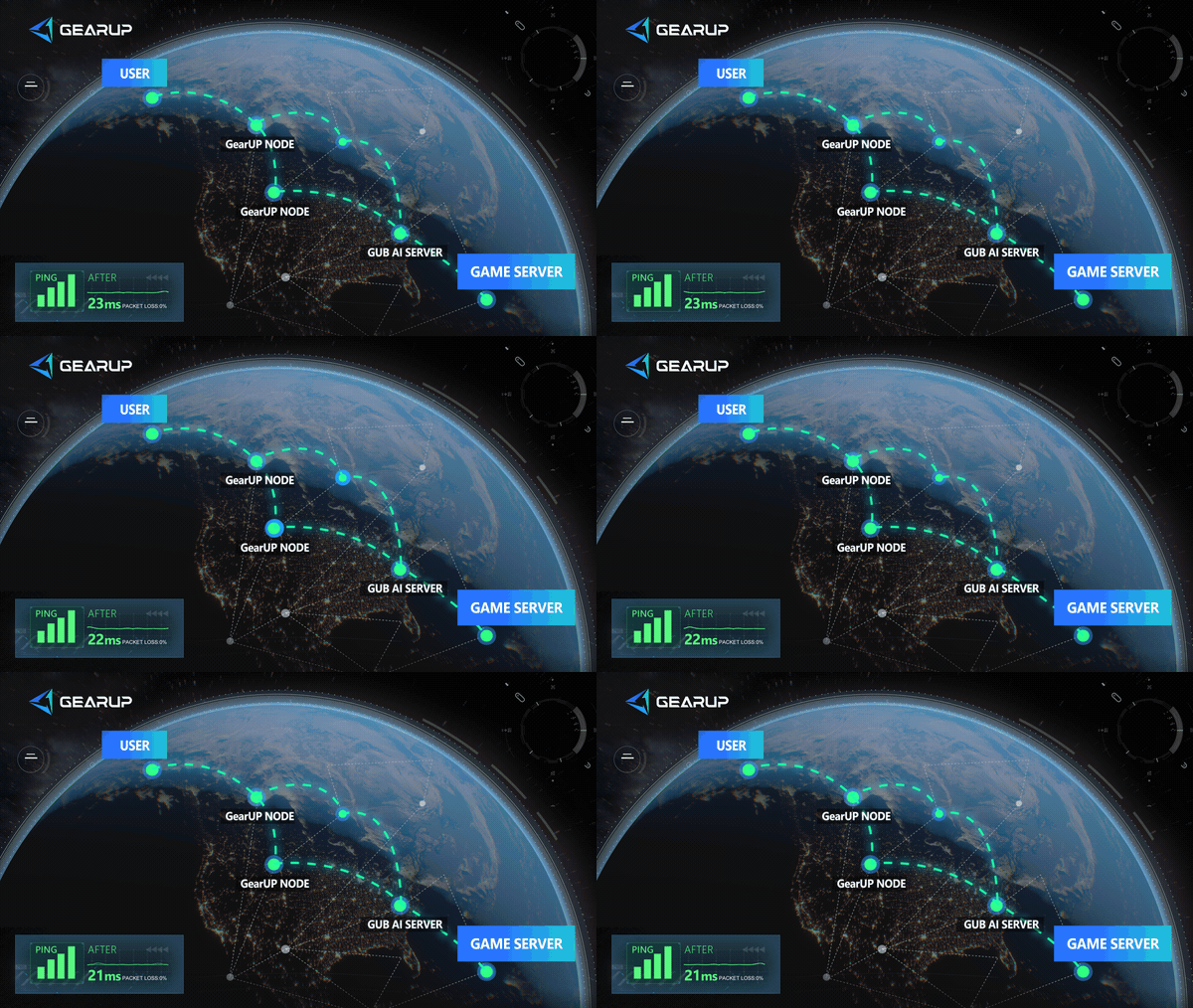
You need a WiFi6 router that specifically optimizes this part of the route — HYPEREV. It will, through its self-developed intelligent multi-line algorithm, select the best nodes in real time based on your network environment and the server you are connected to, greatly improving stability, reducing the time required for data transmission, and thereby lowering game ping. It has the characteristics of an excellent WiFi6 router:
- Plug and play
- Simple control
- Affordable price
If there is any obvious shortcoming, it is that HYPEREV currently does not have dial-up capability; you still need a basic router, but fortunately it can be used in conjunction with any ordinary router. You can watch this video or click the button to go to the store to learn more about HYPEREV:
Bottom line
Currently, Wi‑Fi 6 routers remain the best choice for gaming and everyday use, and they will not become obsolete within the next 3–5 years. Mainstream brands’ products each have their own features, but the differences in daily use are not very large. However, it is worth noting that ordinary Wi‑Fi 6 routers solve the complex network problems inside your home — you can use them to manage your network — while for public network node connections and latency optimization, HYPEREV is the key that can actually make a difference. By learning how to use it, you can more quickly obtain a stable gaming experience.
About The Author
Ethan is one of GearUP's Technical Blog Editors, specializing in gaming network optimization and troubleshooting. With an in-depth understanding of GearUP's technologies, he creates clear, practical content that helps players identify the causes of network issues, understand how game acceleration works, and optimize their online gaming experience. By turning complex technical concepts into easy-to-follow guides, Ethan helps readers solve common connectivity problems and make better use of GearUP's features.
The End